
From Test to Care: Linking HIV and STI Self-Users to Prevention and Treatment Services
TOOLKIT
HIV Self-Testing
Introduction to this Toolkit
Public health departments, community-based organizations (CBOs), and other agencies can use this toolkit to assist with planning or operating a self-testing program or working with TakeMeHomeTM. This toolkit focuses on how to incorporate treatment and prevention linkages for self-testers.
Objectives
Self-testing services can provide valuable entry points for testers to engage in broader health strategies and services. Self-testing programs can support a comprehensive, patient-centered approach to public health by connecting self-testers to a range of services, such as prevention programs, mental health support, and vaccinations. This approach may enhance health outcomes and reduce disparities in care.
To support the development of linkage services, this toolkit focuses on the following objectives:
1. Describe how HIV and STI self-testing can serve as an entry point to other health services, including:
- HIV PrEP (pre-exposure prophylaxis)
- HIV PEP (post-exposure prophylaxis)
- doxyPEP (doxycycline post-exposure prophylaxis) for STI prevention
- HIV/STI treatment
- Substance use harm reduction resources
- Other wellness services or information
2. Identify promising cross-sector partnerships among public health stakeholders to ensure seamless referrals to comprehensive care, such as follow-up testing, counseling, and treatment.
3. Describe how self-testing linkages can be tailored to reach vulnerable and underserved communities, promoting inclusive and equitable services.
What is Self-Testing?
What is Self-Testing?
Self-testing is a rapidly growing healthcare strategy that allows individuals to collect samples and, at times, interpret test results outside clinical settings. While some self-tests have been used for decades (such as in-home pregnancy tests), the COVID pandemic ushered in a new wave of acceptability and familiarity of using screening tools in one’s private space to understand a health concern.
Self-testing for HIV and other STIs reach people, including those who aren’t connected to healthcare systems, for a multitude of reasons, such as systemic barriers, shame and stigma, user preference, and competing life priorities. The benefits of privacy, confidentiality, and convenience stand out as key desirability points from HIV and STI self testers when managing their health and well-being, especially as it relates to sexual and drug user health.
We use the following three definitions to help readers navigate this toolkit for clarity and consistency. As this field continues to grow, these terms will continue to evolve.
Self-Tests
A broad term describing screening tests that an individual can use to detect HIV, STIs, or other health conditions within a home or other space for convenience and privacy. Self-tests, also sometimes referred to as home tests, include rapid-result self-tests and self-collection mail-in tests, defined below.
Rapid-Result Self-Test
A screening test that a person fully performs on themselves to test and get results for a specific health condition. The self-tester collects a sample and then applies it to a test strip or other device to get results in about 20 minutes. These tests are easy to use for the average person, with clear instructions and disposable supplies.
Self-Collection1 Mail-In Test
A diagnostic or screening test that a person performs to collect a specimen for a specific health condition. The self-tester collects a sample (urine; oral, rectal, or vaginal swabs; or blood) and then sends it to a health facility or lab for results. The tester learns the results at a later time. The results are known to the lab and are likely to be reported to a health department or a person’s physician as required by law.
SHAWN…
lives in a small town where everyone knows everybody’s business. He ordered a rapid result self-test online to avoid buying one at a pharmacy or getting tested at a clinic. Shawn stuck his finger with the provided lancet (small needle) to drop some blood on the test strip, per the instructions. He learned the result 15 minutes later, with instructions in case he needed assistance.
ÁNGEL…
hasn’t found a health provider they prefer in their city. They ordered a mail-in STI self-collection test to take their own samples and not have to answer a doctor’s questions. Ángel opened the kit, used the swabs, and took a urine sample before trying the blood test. After some deep breaths, they finished the blood test and packed their completed test tubes and cards into a pre-labeled mailer. Ángel dropped the specimens at the post office during their taxi shift and is keeping an eye on their email for the results in the next few days.
BENEFITS OF SELF-TESTING2
- Complements existing testing and referral services
- Expands potential for linkages to other health and social support services
- Offers privacy and confidentiality
- May reduce anxiety around sexual health and other health topics
- Reduces financial and logistical barriers
- Eases complexity of competing life priorities
- Promotes self-autonomy
- Serves as an option to avoiding negative experiences in healthcare settings
- Supports more widespread acceptance of testing
WHO BENEFITS FROM SELF-TESTING?
PAOLA…
took a break from dating after breaking it off with her long-term partner. The last time she took an HIV test was two years ago, at the start of that relationship. Now that it’s been a few months since the break-up, Paola is dating again and wants to know her HIV status just in case things go well on tonight’s date. Paola bought an HIV self-test online, took it, and got the results before getting ready for her first date.
ELIJAH…
thinks getting tested is a hassle. They lost their health insurance when they were laid off and moved farther out of the city to live with family. Without a car, it would take 90 minutes by bus to get to the closest testing center. Elijah ordered a self-collection test from a free state-run program, collected samples, and scheduled a USPS pickup. No need for a car, health insurance, or scheduling.
CHRIS…
doesn’t always have sterile works or syringes in his rural community, so sometimes he reuses or shares sharps with his friends. He is tired of his doctors focusing on drug abstinence when all he wants is to get tested for HIV and hepatitis C. Chris tried a self-collection test for HIV and hepatitis C using a small amount of blood. He realized how much he preferred doing the test himself.
Footnotes:
For information about self-testing availability and regulation, see Regulatory Landscape: The State of Self-Tests in the U.S. Regulatory Landscape: The State of Home Tests in the U.S. in the Appendix of this toolkit.
1 Self-collection is also possible in a clinic or other in-person setting, where a patient collects their own samples and leaves them at a lab for lab-based processing. This use of self-collection will not be discussed in this document
2 Hecht J, Facente SN, Cohen S, et al. TakeMeHome: A Novel Method for Reaching Previously Untested People Through Online Ordering and Self-Collect HIV and STI Testing. Sex Transm Dis. 2024;51(12):803-809.
TakeMeHome
A SELF-TEST MODEL FOR LINKING PEOPLE TO PREVENTION AND TREATMENT SERVICES?
Self-testing is discreet health testing that meets people where they are. Building Health Online Communities (BHOC) operates the TakeMeHome self-testing program in various locations throughout the U.S. It is the first self-testing program of its kind that reaches beyond the jurisdictional borders that health department-led programs follow. 3 TakeMeHome also has built linkage activities to other health services into its program. To illustrate the linkages process, let’s look at TakeMeHome as one model. 4
Background
In March 2020, TakeMeHome launched in select locations5 throughout the U.S. by offering free HIV self-tests (OraQuick ®) with a focus on reaching key populations who use dating apps. However, the platform is open to all people in participating locations for lab-based STI testing and PrEP labs, rapid-result HIV oral swab tests, rapid-result HIV fingerstick tests, and rapid-result syphilis self-tests.6 TakeMeHome also supports public health partners prioritizing specific communities who could benefit from self-testing including women, unhoused people, sex workers, and people who inject drugs.
How It Works
TakeMeHome centralizes logistics for local health departments and large CBOs to make self-testing a reality in places that aren’t funded to create programs on their own. Agencies that use TakeMeHome can choose the type of mailed tests offered and the eligible people they want to reach.
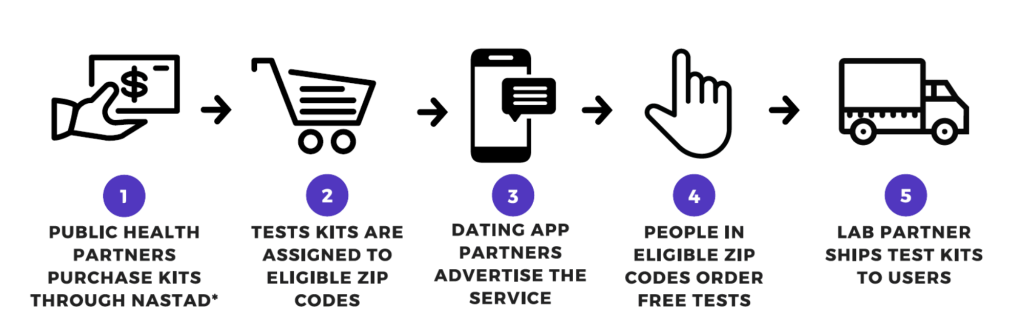
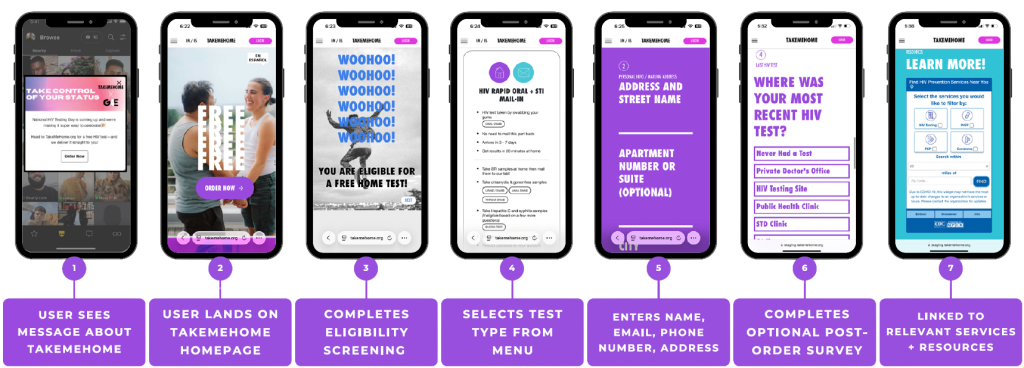
TakeMeHome then leverages BHOC’s partnerships with dating platforms to notify participants in eligible zip codes to order a free self-test. These partnerships drive about 50% of the traffic to the program, through features developed by BHOC such as order buttons directly in the dating apps, links to TakeMeHome in the apps’ sexual health resource centers, and geo-targeted messages encouraging app users to place an order.
NASTAD is an association that represents public health officials who administer HIV and hepatitis programs in the United States. NASTAD oversees the contracting and payment processes for TakeMeHome partners.
Tests Offered
RAPID-RESULT SELF-TEST:
- HIV Oral Swab (OraQuick®) or HIV Fingerstick (INSTI®)
Users are sent an HIV rapid-result self-test, with detailed instructions, information about confirmatory testing, and HIV/STI prevention and care resources. - Syphilis (First to Know®) Blood Test
Users are asked about their interest in receiving the syphilis rapid-result self-test and their syphilis history (to determine eligibility). The self-test will be sent with their HIV oral swab test, with information on how to use the test and what to do after receiving results.
SELF-COLLECTION MAIL-IN TEST:7
- STI testing
Three-site specimen collection for chlamydia and gonorrhea, and dried blood spot collection for syphilis, HIV8, and hepatitis C are available in select areas. Users send specimens in the included postage-paid return packet to a specified lab. HIV testing is included unless someone opts out (from self-tester’s reports, usually because they are living with HIV). Syphilis and hepatitis C testing are available for those who are eligible. - PrEP panels
For participants already using oral PrEP, the program has an oral PrEP maintenance panel option, which includes HIV dried blood spot and creatinine testing. For those looking to start oral PrEP, the program offers an oral PrEP initiation option, which adds hepatitis B testing.
Results Delivery and Reporting
One of the main questions public health agencies have is how results are reported to users and then communicated to public health departments when someone tests positive or has an inconclusive result. TakeMeHome communicates results with participants via email and SMS (text) with a follow-up survey and further resources, including the Positive Resource Center (delivering results and linkages to testers occurs at steps 3-4 in the graphic on LINKAGES AT EVERY STEP OF SELF-TESTING).
Overall results delivery can more clearly be broken down by the test type:
Rapid Result HIV and Syphilis
Users of the OraQuick® self-administered swab and self-administered blood tests INSTI® and First to Know® get their results in real time after taking the test, and can report the results in the TakeMeHome™ follow-up survey. With users consent, test results voluntarily reported in the follow-up survey may be shared with the local health department. Additional support resources are available, detailed later in this toolkit.
STI testing and PrEP panels
Participants can access the results of their STI andPrEP panel self-collected specimens using a secure portal hosted on the TakeMeHome website. (Refer to step 3 on the graphic on LINKAGES AT EVERY STEP OF SELF-TESTING.) Positive results that require reporting will be sent automatically to the local health department by the TakeMeHome lab partner, Molecular Testing Labs. Participants with positive test results will get follow-up from their local jurisdiction, as well as links to geo-targeted testing, treatment, prevention, and other healthcare services. (Refer to steps 4 and 5 on the graphic on LINKAGES AT EVERY STEP OF SELF-TESTING.)
Linkages
Self-testing services provide a powerful entry point for connecting self-testers to a broader range of essential health services. TakeMeHome ensures that participants not only receive their test results but also are supported with linkage to care and prevention resources. To accomplish this, TakeMeHome leverages key assets such as a dedicated support team, informative materials within the self-test package, key information and referrals within the online ordering process, and the inclusion of health supplies like condoms and naloxone. This comprehensive approach encourages testers to take proactive steps towards their broader health and well-being.
Support Team
The TakeMeHome support team is the first line of support for participants. Most support requests involve order fulfillment, product availability, and participant follow-up on their returned samples. The support team also is connected to a vast range of local resources—provided by participating public health partners—and often links participants to local services for further testing, treatment, and other health needs.
TakeMeHome could be considered a “hub and spoke” model, in which BHOC works to recruit individuals to the TakeMeHome site, offers ordering and fulfillment services, and collects and reports data while partnering with local sites on linkage. In this way, participants can connect with their local health departments, CBOs, or other support services that are best suited for follow-up care. Program partners can provide their own resources through a local-specific resource page. For self-collection testing, jurisdictions must have a medical provider, such as an MD or NP (any provider with an NPI [national provider identified]) connected to the program as part of their onboarding, who will function in a similar manner to “standing orders.”
TakeMeHome encourages local health departments to use the self-testing program in a manner that aligns with their needs. Many health departments employ Disease Intervention Specialists (DIS) or navigators who follow up with testers. For self-collection tests, qualified healthcare staff can access the lab portal to review test results. TakeMeHome encourages program partners to check the portal at least one or two times per week in order to provide follow-up for positive test results. Health departments may incorporate this partnership into their regular workflows.
Some DIS use the program as a last offer of testing to contacts who do not respond to requests for interviews or suggestions to test.
Website
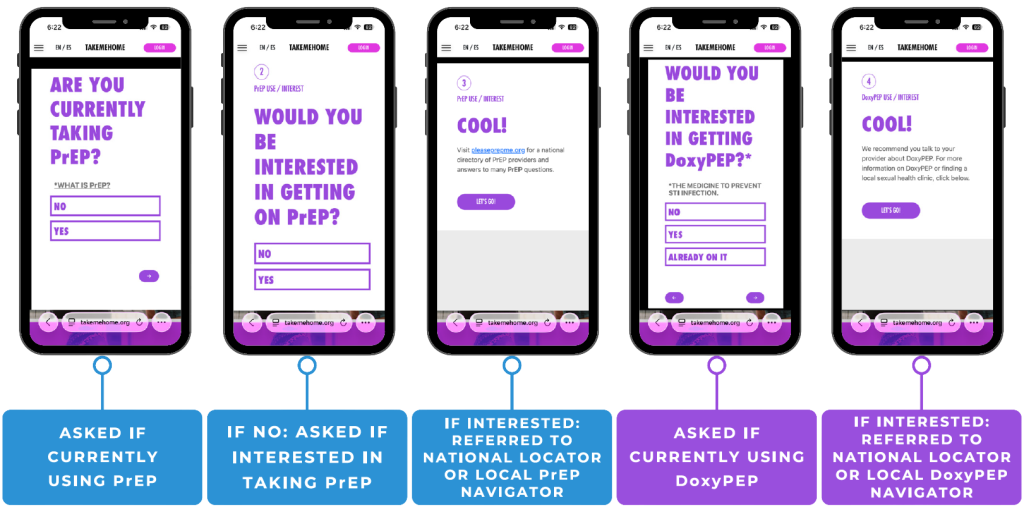
In the initial order process for self-tests and self-collection tests, participants also are asked if they currently use PrEP or doxyPEP. If they do not and are interested in learning more or finding a provider, they are redirected to information provided by the local health department. All participants receive additional basic information about STI testing, PrEP, doxyPEP, condoms, U=U (undetectable=untransmittable), harm reduction, contraception, and pregnancy at the final step of the process on a localized resources page. Later, when self-collection testers login to view their results, those with a positive test result also are encouraged to share positive test results with their sex partners. This can be accomplished through anonymous partner notification facilitated by their health department or with suggestions for having the discussion themselves. All participants can review follow-up steps for each STI they test positive for in the Positive Resource Center.
Printed Materials
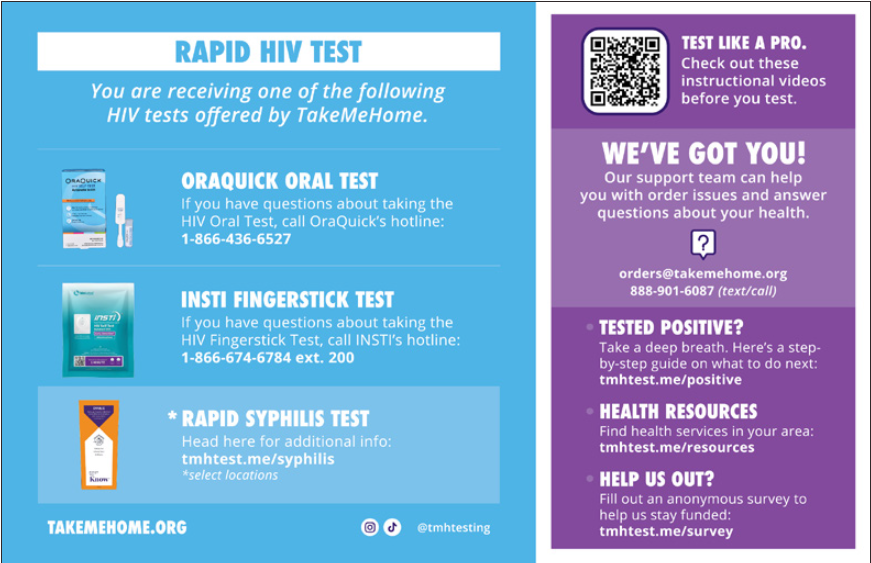
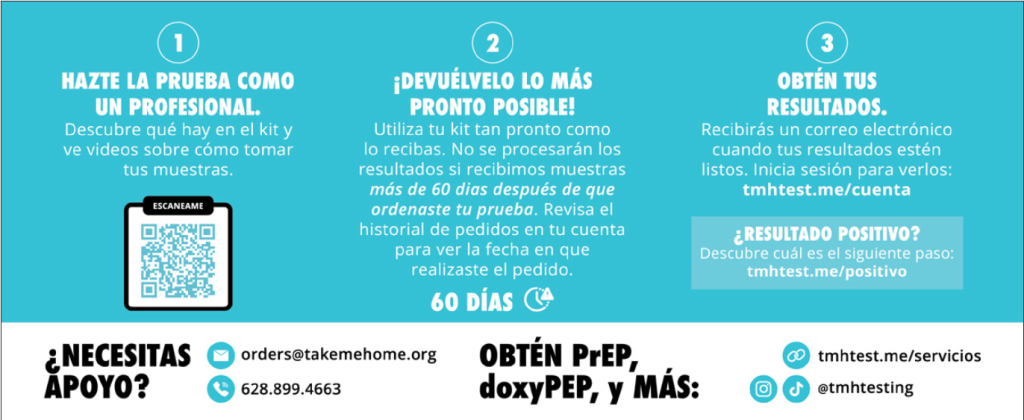
In addition to instructions for how to take samples for each part of the test process, TakeMeHome testers receive a printed process map in their order (examples pictured below). This provides them with key resources, timelines, and contact information for support.
RAPID HIV & IN-HOME SYPHILIS TESTS
SELF-COLLECTION MAIL-IN TESTS (Spanish Version)
Supplies
All participants automatically receive condoms included in their order. Some locations offer naloxone as an optional add-on, separately fulfilled by a local health department or harm reduction program. While TakeMeHome does not provide medications for treatment or biomedical prevention, it has collaborated with health departments to create a seamless PrEP linkage process either through in-person navigation and support, or telehealth, to engage TakeMeHome participants in biomedical HIV prevention.
IMPACT
TakeMeHome was created to address gaps in testing for people using dating apps. While TakeMeHome’s reach has expanded, the primary goal has been to increase access to testing. Consistently, about 50% of participants are age 30 or younger, and about one third of all participants report TakeMeHome as their first HIV test.
The team works with participating jurisdictions to tailor their local eligibility criteria by zip code, age, and time since their last HIV test. Demographic factors such as race, ethnicity, and sexual orientation are not factors in eligibility, but are collected optionally after ordering.
BHOC’s deep partnerships with dating apps have led to high recruitment among men who have sex with men (MSM); however, women currently make up about 30% of participants. BHOC has developed recruitment materials for their local partners that include wide representation of all key populations.
Footnotes:
3 Hecht J, Facente SN, Cohen S, et al. TakeMeHome: A Novel Method for Reaching Previously Untested People Through Online Ordering and Self-Collect HIV and STI Testing. Sex Transm Dis. 2024;51(12):803-809.
4 TakeMeHome is just one of many self-testing models, along with state-led and city-run programs in different jurisdictions. Any mentions of specific tests used by TakeMeHome are not endorsements of those products.
5 In March 2023, TakeMeHome’s model was taken national in a separate program called Together TakeMeHome. The program only sends OraQuick® In-home HIV tests and does not provide self-collection testing for other STIs. Read more about the national program in this CDC report.
6 Age restrictions may apply for certain tests, depending on location. The OraQuick HIV test is available for people 14 years of age and older.
7 In October 2024, the FDA released a letter calling for all labs to cease offering remote HIV self-collection testing. TakeMeHome stopped offering lab-based HIV testing. HCV and syphilis results are still offered on the DBS. See more in this appendix.
8 Due to the FDA’s decision, TakeMeHome stopped offering PrEP labs as well since HIV DBS testing was used to confirm a participant’s status before starting or continuing PrEP.
Linkages at Every Step Continuum
LINKAGES AT EVERY STEP OF SELF-TESTING
This section identifies linkage options appropriate for different steps in a self-tester’s journey and provides recommendations for how programs may embed linkage opportunities at each step of the process.
As illustrated in TakeMeHome’s model—as well as in others—most of the work to link participants to resources happens during the order process or before the participant takes their self-test. Due to the nature of self-testers being in their own space and not required to engage with a healthcare professional, it’s necessary to preempt specific linkage needs.
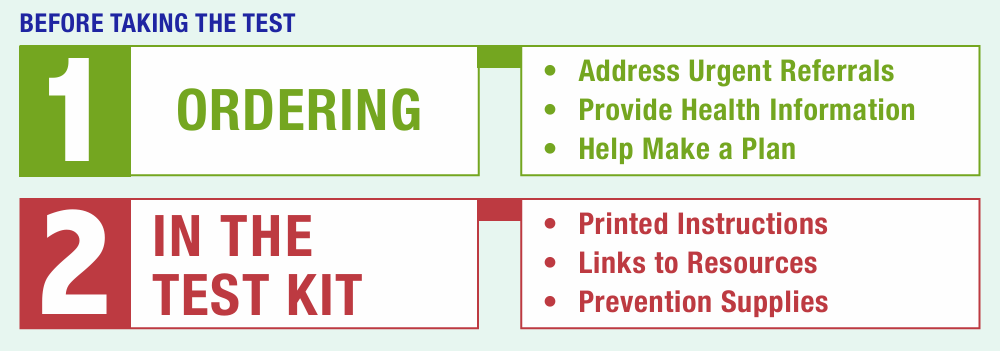
Ordering
Proper linkage before someone uses a test can significantly enhance the participant’s experience, increase the likelihood of accurate use, and ensure that they are well prepared for the steps after taking the test. These linkage options should focus on education, resources, and support to promote confidence and informed decision making. Opportunities to provide additional material supplies for HIV and STI prevention are key in this phase as well.
ADDRESS URGENT REFERRAL NEEDS FOR PARTICIPANTS IN THE ORDER PROCESS
Participants may order a self-test because of an urgent need for results. These include having symptoms, having confirmed exposure, or other time-sensitive scenarios. The order process includes referrals to healthcare services and guidance on what actions to take if a person is symptomatic, has recently been exposed to HIV or another STI, or is in need of immediate crisis intervention.
Symptomatic Referral
If a participant reports symptoms that may be related to a possible infection, the order process should include a referral that encourages them to seek immediate care from a healthcare provider for a full exam, testing, and treatment.
Exposure Referral (HIV)
If a participant reports a recent HIV exposure (e.g., condom break, sexual assault, shared syringes/works), they should be referred to PEP (postexposure prophylaxis) services and an exam from a healthcare provider. Asking a question to confirm if they are within the 72 hours of exposure window is essential in getting them immediate support.
Exposure Referral (other STIs)
If a participant reports a recent STI exposure (e.g., sex partner with STI diagnosis, sexual assault), they should be referred for STI treatment and an exam from a healthcare provider.
Sexual Assault Referral
If a participant reports a recent sexual assault as their reason for wanting to test, they should be referred to specialized survivor resources that are more holistic than a home HIV or STI test alone. These may include: initiating HIV PEP, presumptive STI treatment, mental health support, emergency contraception, and a sexual assault forensic exam. These services are essential, timely, and specialized beyond the scope of most HIV and STI programs.
Emergency Contraception Referral
By including an option to indicate the need for emergency contraception, programs can connect testers to timely and confidential information about the medication and where to find it.
PROVIDE ADDITIONAL HEALTH INFORMATION WHILE PARTICIPANTS ARE ENGAGED IN THE ORDER PROCESS
PrEP Info
Within the order process, include a definition of PrEP and who can use it. Offer a PrEP referral link (such as PrEPLocator.org) or contact information for local clinics or healthcare providers where testers can access PrEP. Highlight locations with information about insurance coverage, payment assistance programs, or sliding scale fees as well as general accessibility info.
DoxyPEP Info
Within the order process, include a definition of doxyPEP and who can use it. Offer a doxyPEP referral link (such as FindDoxyPEP.CDC.gov) or contact information for local clinics or healthcare providers where testers can get a prescription. Highlight locations with information about insurance coverage, payment assistance programs, or sliding scale fees as well as general accessibility info.
Local Resources
Consider having participants end their order on a landing page with localized information and resources related to sexual health, mental health, drug use and harm reduction, pregnancy options, and contact information for local clinics or health departments. Self-testing programs can be a prime opportunity to engage people in the healthcare system when they might not otherwise.
Program Instructional Resources and Contact Information
Show participants what resources are available on the program’s website. Including a “How It Works” page (including instructional videos) after their order is placed may help participants plan ahead for how to take the test and sets expectations for completing the process. Contact information for the program’s support team to answer questions about their order is essential. Additionally, contact information for the test’s manufacturer will provide additional details on the test device itself.
In the Test Kits
PROVIDE CLEAR INSTRUCTIONS AND EDUCATION IN THE SELF-TEST PACKAGE
Before participants begin the self-testing process, it is vital they receive clear and accessible instructions. This includes guidance on how to conduct the test properly and interpret the results.
The following elements should be included in the test package:
- Test Instructions
Provide proper instructions to help testers understand how to collect the sample, perform the test, and interpret the results accurately. Instructions typically are provided by the test manufacturer but can also include PDFs, video links, and web-based resources (see this link for example Rapid HIV Test Demonstration – Whole Blood Finger Stick Sample). - Process Map
A material that focuses on the full process of self-testing can be key to help testers not feel overwhelmed and see self-testing as something with clear steps. These guides may include links to instructional videos, a page for what to do after you get your results and contact information if a tester needs additional help. - Information on HIV, STIs, and Testing
Basic information on the STI a participant is testing for can help educate them and provide facts to ease anxieties they may have, including a brief explanation of the STI, how it is transmitted, and the importance of regular testing. Providing details on the efficacy of the test also may reassure testers. Finally, information on the window period of the test(s) and an explanation on why regular testing is important can round off this section.
INCLUDE PREVENTION SUPPLIES WITH THE SELF-TEST KIT.
Incorporating material prevention supplies into the self-test package can address an array of health needs. By providing these supplies, programs can support people in preventing HIV, other STIs, and other health needs. Including these tools can encourage testers to take proactive steps for their health.
- Condoms
Including condoms is a straightforward way to promote condom use. Condoms are a cheap, effective way to prevent HIV, most STIs, and pregnancy. While many people can find them for free, self-test programs may be sought out by people with limited income or who don’t navigate spaces where free condoms are available. Consider offering various options, including roll-on condoms, internal condoms, non-latex options, and different sizes. - Lube
Add packets of water- or silicone-based lubricant in the self-test package. Lube can prevent condom breakage and discomfort. Lube also reduces microtears in the skin when condoms aren’t used, which increase the transmission of HIV or other STIs. Free lube can be hard to find for most testers. - Harm Reduction Supplies
Offering naloxone or drug test strips can help connect people who use drugs to overdose prevention. In some cases, offering supplies that prevent HIV and hepatitis C—like injection, smoking, or snorting supplies—also may be possible. Partnerships with existing harm reduction and syringe service programs (SSPs) can assist with concerns related to local legislative requirements or programmatic expertise. - Pregnancy Tests
Offering in-home pregnancy tests can support people who have the capacity for pregnancy and their partners.
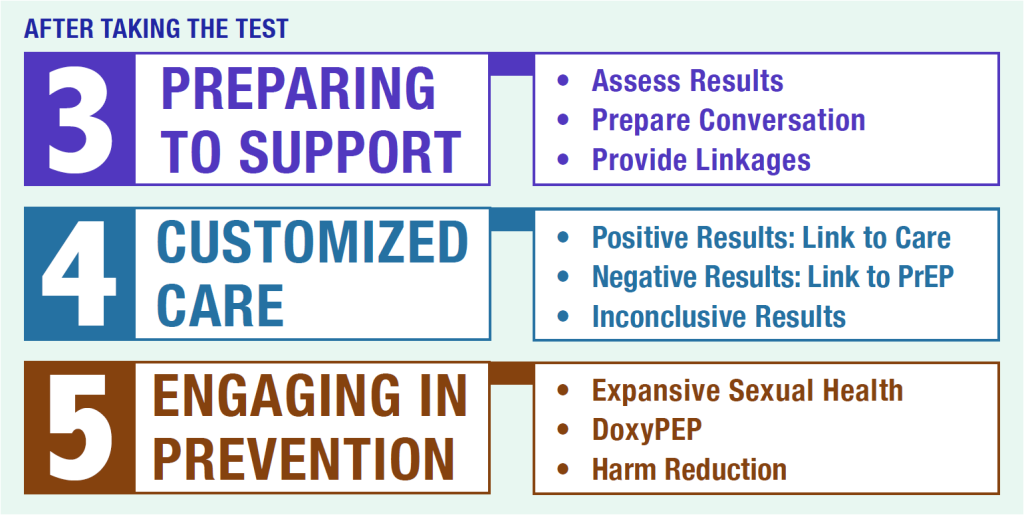
Preparing to Support
ASSESSING RESULTS
In a traditional sense, linkage to care, treatment, and other services typically happens after knowing someone’s specific test result. For self-testing, two pathways help capture these results: self-reported and lab-reported.
SELF-REPORTED RESULTS
Reporting results from a rapid-result self-test is entirely up to the tester. There are many ways you can support a self-tester sharing their results, including positive results.
Within the self-test packaging.
Most testing devices will have a 24/7 hotline staffed by the manufacturer to answer questions about testing or supporting those who received a positive or inconclusive test result.
Direct people to access follow-up without requiring results reporting
In addition to the previous bullet, linking to a Positive Resource Center with step-by-step instructions on what to do can help testers access necessary steps. One of those follow-up steps may be explaining why it can be helpful to report a result they received at home.
Add an optional results section to follow-up surveys
If assessing any impacts of your self-testing or linkage program, add a confidential section for people to list their result and/or their name and contact info if they want assistance.
Establish a localized hotline in your agency
While TakeMeHome has a Customer Service team available to support with orders and additional linkage support, you also can list a number or email specifically for those with positive results to get connected to care.
Add self-testing program to partner intake forms
If you have linkage partnerships with clinics, CBOs, or individual healthcare providers, ask them if they could ask about prior use of the self-testing program on their intake forms. This can help anonymously track the follow-up rate that may be happening for self-testers.
LAB-REPORTED RESULTS
Laboratories are required to report positive results from self-collection tests by law. Local jurisdictions also are able to access the lab portal to see individual results and follow-up with testers for additional testing and treatment as needed.
Because linkage professionals have direct access to results, it’s essential to ensure that follow-up communication with self-testers—via email or phone—includes stating their partnership with the self-testing program.
FROM A TESTER’S PERSPECTIVE…
they may have been on a dating app, clicked on a link, and ordered from TakeMeHome. While people consent to follow-up during the order process, they may not recall this detail, so restating the program name is important. For example:
“Hi, my name is Maria. The health department is working with TakeMeHome to provide additional, localized support for you.”
Likewise, if a local jurisdiction emails testers, it’s essential to include the connection to the self-testing program and include the self-testing program’s logo in their email template.
Below are resources with essential questions and talking points to bring up in your linkage work:
- HIV Nexus: The U.S. CDC has clinician and patient guides, posters, and resources about different HIV linkage options.
- Why Language Matters: Facing HIV Stigma in Our Own Words: This resource from The Well Project discusses how to remove stigmatizing language from your conversations about HIV.
- Greater Than AIDS Provider-to-Provider videos: Kaiser Family Foundation (KFF) created a series of short videos about best practices for healthcare providers related to PrEP and broader sexual healthcare. For patient audiences, KFF and the U.S. CDC partnered to create a playlist of videos about HIV-self tests and other core HIV topics.
Customized Care
SUPPORT BASED ON RESULTS
Some prevention resources are going to be specific only for people who test negative or positive. Below, are resources tailored to positive HIV test results, positive STI test results, negative HIV test results, and when a test is inconclusive or didn’t work.
POSITIVE RESULTS: HIV
Receiving a positive result from an HIV self-test can be a moment of significant distress, fear, confusion, and shame. When a tester receives a positive HIV result, it is essential to quickly connect them to further testing, treatment, and support in the short- and long-term. Linkage support should prioritize not only confirmatory testing and medical care but also mental health and social support to help them navigate next steps. The following outlines key components of linkage support for people in this situation.
Ensure participants can take next steps even without assistance
As a reminder, linkages (especially for positive results) begin during the order process and before the tester starts a self-test. Self-testers have control over knowing their status, so that same level of autonomy should be evident in providing clear information that they can choose to follow up on their own. (See an example of an HIV-specific post-test resource center at Together.TakeMeHome.org/support.)
Answer questions and provide assurance
Unlike many other STIs, HIV holds additional weight for stigma and fear for many people. Some self-testers may need some time to process their positive result before reaching out. Being a calm presence who can answer questions and assure them that they can live well with HIV may be a necessary first step before urging they seek medical support right away.
Confirm self-test results
A key step in the linkage process is confirming the self-test result through laboratory testing. The tester should be referred immediately to a nearby healthcare facility for confirmatory testing. This can be achieved through:
- Automated referrals: Integrating a referral system via text or email to direct individuals to local testing centers that provide confirmatory testing.
- Supportive guidance: The self-test program’s support team should be available to assist with the logistics of visiting a clinic, including advising on transportation options, appointment scheduling, cost details, or additional information to reduce barriers to follow-up testing and care.
Encourage partner notification
Provide support for those with positive results in notifying their partners about a confirmed HIV diagnosis and encouraging them to get tested. This can be done confidentially through partner notification services initiated by health departments, or by guiding individuals to inform their partners on their own using this information from CDC.
Offer prevention education
Those with positive results should receive information to pause their sexual contact while awaiting confirmatory testing, and for some time after starting treatment. This time is necessary to bring their viral load to an undetectable level, which in turn prevents transmitting HIV to others (also known as Undetectable = Untransmittable, or U=U). They will need to take their medications as prescribed and lab testing to monitor their viral load. Testers should also receive education on HIV prevention practices for their HIV-negative partners, including PrEP, condom use, and the importance of regular HIV testing.
POSITIVE RESULTS: OTHER STIs
When participants test positive for an STI using a self-test, it is critical they are linked quickly to clinical services for follow up, which may include confirmatory testing, an exam, and treatment. Self-testers may experience distress and shame among other feelings. Linkage support should prioritize not only treatment access but also access to information about treatment timelines and referrals to STI prevention tools. The following outlines key components of linkage support for people who test positive for other STIs on a self-collection test.
Ensure participants can take next steps even without assistance
As stated earlier, linkages (especially for positive results) begin during the order process and before the tester starts a self-test. Self-testers have control over knowing their status, so that same level of autonomy should be evident in providing clear information that they can choose to follow up on their own. Here is an example of a multi-STI Positive Resource Center.
Answer questions and provide assurance
While many STIs may not carry the same emotional weight as HIV for participants, each person is unique. Stigma and shame around STIs still hold strong in many communities, even those that can be cured. Some self-testers may reach out panicked or upset that they have an STI. Being a calm presence who can answer questions and assure them that most STIs are curable while others are manageable illnesses can be a necessary first step even before they seek medical support right away.
Confirmatory testing as needed
Ensure required confirmatory testing is included in the process. While self-collected, lab-processed gonorrhea and chlamydia tests do not need confirmation, other tests such as HIV and syphilis will.
Encourage partner notification
Provide support for those with positive results in notifying their partners about a confirmed HIV diagnosis and encouraging them to get tested. This can be done confidentially through partner notification services initiated by health departments, or by guiding individuals to inform their partners on their own using this information from CDC.
Supporting access to treatment
A key step in the linkage process is to connect testers to a healthcare provider for treatment, further exam, and/or testing. Refer testers immediately to a nearby healthcare facility, which can be achieved through:
- Automated referrals: Integrate a referral system via text or email to direct individuals to local treatment options (e.g., telehealth pharmacies) or clinics that provide treatment and/or additional testing.
- Supportive guidance: The self-test program’s support team should be available to assist with the logistics of visiting a clinic, including advising on transportation options, appointment scheduling, cost details, or additional information to reduce barriers to follow-up testing and care.
Offer prevention education.
Those with positive results should receive information to pause from sexual contact for some time after treatment to prevent additional transmission. Inform them they may need to retest in a few weeks to confirm the medications cleared their infection. Testers also should receive education on prevention practices, including doxyPEP, condom use, and the importance of regular STI testing, to reduce the risk of reinfection and transmission to others, as well as resources for HIV treatment and prevention.
NEGATIVE RESULTS: HIV
While the focus of HIV self-testing programs is often on people who test positive, providing comprehensive post-test support for people who receive a negative result is equally important. Negative HIV results can provide an opportunity to engage individuals in prevention strategies, particularly for those who are more vulnerable to contracting HIV. Linkage to PrEP (and other prevention methods) following a negative HIV test is a crucial component of any self-testing program, as it allows individuals to remain proactive beyond testing in preventing HIV.
Automated or Assisted Referrals
The self-testing program can offer automated referrals via mobile apps or text messages that guide individuals to local clinics, healthcare providers, or pharmacies where they can receive PrEP prescriptions. Additionally, trained PrEP navigators or counselors can offer personalized support to help individuals understand the next steps and make appointments for PrEP consultations.
Direct Linkage to PrEP Clinics
Self-testing programs should collaborate with local healthcare clinics, HIV prevention centers, or public health agencies to ensure self-testers can access PrEP services. These clinics should have the capacity to provide PrEP education, eligibility screening, prescription services, and ongoing monitoring of side effects or health concerns. Consider options that include telehealth, since self-testers appreciate at-home services.
Supportive Guidance
The self-test program’s support team should be available to assist with the logistics of visiting a clinic or accessing tele-PrEP, including advising on transportation options, appointment scheduling, cost details, or additional information to reduce barriers to starting PrEP.
INCONCLUSIVE RESULT OR TEST DIDN’T WORK: RE-TEST
There may be situations where HIV self-tests don’t work as intended or produce an inconclusive result. These scenarios may confuse or frustrate self-testers. It is essential that self-testing programs have clear replacement procedures in place in these situations. Supporting a tester through an inconclusive result is crucial for ensuring that participants make informed decisions about their next steps and seek appropriate follow-up testing.
User error or test problems
User error and other issues that prevent a test from functioning properly can be frustrating. (For example, a tester dropped an essential liquid-filled test tube, or a component of the test was missing.) Make sure testers know they can get a replacement test if they make a mistake. If they cannot wait on a mailed replacement, a self-test program support team can link them to in-person testing.
Troubleshoot before retaking the test
Support staff or online resources should guide a self-tester through the test procedure to identify any potential errors. This might include verifying that the test device was used correctly, the sample was sufficient, or the expiration date had not passed.
Understand additional support needs for inconclusive results
An inconclusive result occurs when the self-test does not provide a clear positive or negative result, often due to an insufficient sample, improper test procedure, or device malfunction. This may cast doubts on self-testing and stoke fears about a preliminary positive HIV result. Additional questions may need to be answered, especially if the tester may now have some distrust of the device and process.
Case Studies:
Supporting Virginians who Test Positive on Rapid HIV Self-Tests
The Virginia Department of Health (VDH) offers free HIV self-tests to eligible state residents age 17 and up through its Home HIV Testing Program. If someone receives a positive result from an at-home test, the next steps involve confirmatory testing, counseling, and linkage to care. As part of the post-test survey, clients are asked to report their test results.
If a client indicates a positive result, they are asked whether they have obtained confirmatory testing or if they need assistance in doing so. For those who need help, they are prompted to complete a Coordination of Confirmatory Testing Assistance form, which serves as consent for VDH to reach out and facilitate access to confirmatory testing. Once the form is submitted, a DIS worker from the client’s city will contact them to arrange free confirmatory testing and provide guidance on next steps.
Clients also can decline VDH assistance and manage their follow-up care independently. To support this, each test kit includes contact information for local CBOs that offer free rapid and conventional confirmatory testing services. These organizations can also provide additional resources, such as linkage to medical care, counseling, and support services. Ensuring that clients have multiple options for confirmatory testing and follow-up care helps promote early diagnosis, timely treatment, and overall well-being.
Supporting Self-Testers with Positive HIV and Syphilis – NEW MEXICO
The New Mexico Department of Health (DOH) uses TakeMeHome to provide self-collection testing to their residents. To support people with positive HIV and syphilis results reported to the DOH from the lab, the New Mexico team developed the following protocols. As of September 2025, 100% of all testers with positive HIV and syphilis results have had contact with their DIS team and have been offered treatment.
PORTAL REVIEW & CASE ENTRY
- Each Tuesday and Thursday, the HIV Prevention or Surveillance team checks the results portal for TakeMeHome’s lab partner for new positive results.
- The result is logged into Prism, a national database and tracker. If the test result comes through electronic laboratory reporting (ELR), it is uploaded automatically.
CLIENT CONTACT & INITIAL OUTREACH
- Using client-provided information, the team creates a Prism profile and attempts to contact the client for follow-up.
- The team will reach out first before engaging the regional team.
REFERRAL TO A DIS SUPERVISOR
- Once the client’s region is identified, the team notifies the area’s DIS Supervisor to coordinate care.
- If the HIV Prevention or Surveillance team is unable to contact the client, the DIS team will conduct follow-up outreach.
Eskenazi Health Centers Removes Major Barriers with PrEP-related Self-collection tests – INDIANAPOLIS, IN
Eskenazi Health Centers leverages TakeMeHome to support patients who face transportation or other barriers that prevent them from attending an initial PrEP appointment. Participants can test at home with the use of a PrEP Panel, and then, if appropriate—after a telehealth appointment with Eskenazi healthcare providers—get their oral PrEP prescription sent to the pharmacy of their choice. Eskenazi also uses TakeMeHome HIV finger stick tests to perform outreach by educating patients on PrEP who performed the single test.
Engaging in Prevention
POST-TEST WHOLE PERSON SUPPORT, EDUCATION, & NAVIGATION
The following linkage options can be provided to self-testers regardless of their HIV or STI results or status. Whole person (sometimes referred to as status neutral) support involves connecting people to the services they need without considering their HIV status. Whole person support invokes the social determinants of health to address the systemic issues connected to health, wellbeing, and safety; these may include healthcare access, housing, food, and other community resources. Programs may consider referring to national organizations, as well as linking clients to local resources when possible.9
Four key health-related areas that programs may prioritize include:
- Incentivize Follow-Up After Any Negative Result
Self-testers may feel that once they get negative results, there is nothing more to do until the next time they test. Consider providing a resource center that involves multiple options for post-test linkages. See an example of a whole person resource center at Together.TakeMeHome.org/support. - DoxyPEP Education & Navigation
Doxycycline post-exposure prophylaxis (doxyPEP) taken within 72 hours after sex has been shown to dramatically reduce the risk of acquiring syphilis, chlamydia, and gonorrhea among specific populations, including men who have sex with men. By promoting doxyPEP alongside self-testing, programs can offer an immediate means of reducing the risk of these infections, particularly in more vulnerable people, such as those having condomless sex, people with multiple sex partners, or sex workers. Self-testers should receive information on what doxyPEP is, how to access it through pharmacies, clinics, or telehealth services, and clear instructions on when and how to use it. Here’s what doxyPEP integration could look like:- Education: DoxyPEP is not yet as widely known as HIV PrEP so it requires a bit of education for participants to understand how they might benefit. Providing resources in multiple areas such as the program’s website, in printed materials, or through a support team is essential.
- Order Process Follow-Up: For testers who are interested in doxyPEP, consider contacting them individually to offer support or answer questions. This may provide an opportunity to identify people who may be good candidates for doxyPEP navigation.
- DoxyPEP Navigation: Consider delivery options that include telehealth, since self-testers appreciate at-home services.
- Expansive Sexual Health Services Navigation & Support
HIV and STI self-testing programs can facilitate access to a broader array of health services; these services offer testers opportunities to address other aspects of their sexual health care. Programs can develop printed or virtual resources or direct participants to local services.- Vaccines: Individuals can be referred to resources or local health providers for recommended vaccinations, such as for HPV, hepatitis B, mpox, and meningococcal infection. Linkage professionals can answer questions about eligibility and direct individuals to local clinics or vaccination sites.
- Contraception: This can include offering printed materials or website links to information on different contraceptive methods and instructions on how to access them through health providers.
- Pregnancy Options & Services: Self-testing programs also can act as an entry point for individuals needing pregnancy-related services, including termination care. Information in the self-test package or website can guide users to trusted abortion providers or clinics offering pregnancy counseling and support. Linkage professionals can assist by offering confidential, non-judgmental advice and help users navigate their options based on local laws and available services.
- Other Support Services Related to Health & Wellness: Clients may have a range of health priorities or needs to consider that overlap with their overall health and wellness. Some examples may include: crisis mental health support, intimate partner/sexual violence resources, sex addiction services, and support around sexual orientation.
- Harm Reduction and Drug User Health Services
While HIV and STI testing programs tend to focus on the sexual health of a tester’s life, integrating drug user health strategies and harm reduction services can greatly benefit self-testing programs. Expanding language to include behaviors and experiences unique to people who use drugs can help connect services to those who typically have high discretion needs and lower access to care. People who inject drugs can benefit from HIV and viral hepatitis testing, regardless of their sex lives. And for those who have chemsex or unique experiences related to their sexual health, the following linkages can be crucial.- Harm Reduction Strategies: Self-testing programs can include information about harm reduction approaches such as safer drug use practices, safe injection techniques, and prevention of overdose and overamping. Printed materials in the self-test kit or on the website can direct self-testers to local harm reduction services, which may offer education, support, and access to naloxone, sterile injection supplies, drug checking/test strips, and safer smoking kits.
- Syringe Service Programs: SSPs are vital in preventing the transmission of bloodborne infections like HIV among people who inject drugs. Self-testing programs can refer and link testers to SSPs to access sterile injection equipment and other services such as counseling or vaccinations. Programs can also partner with SSPs to offer delivery of naloxone and other harm reduction supplies to self-testers.
- Treatment Programs: Self-testing programs also can connect self-testers to medication assisted treatment (MAT) programs for smoking, alcohol, or drug use. Printed materials and online resources can provide information about local or virtual cessation programs, peer support groups, and behavioral health resources.
Case Study
Sending Life-Saving Naloxone with Self-Tests in San Francisco: TakeMeHome partners with the San Francisco Department of Public Health Office of Overdose Prevention to make naloxone (an opioid reversal drug) available to self-testers. After ordering a self-test, about 3 in 5 people living in San Francisco choose to add a free naloxone kit to their order.
Naloxone logistics are managed locally. A weekly report is sent to the local health department team who procure and ship naloxone to participants. This means that participants receive two shipments, one with a self-test and one with naloxone. The naloxone kit includes information on overdose response, treatment palm cards, and materials about the Never Use Alone phone service, Brave App, and additional drug user health services.
Other Considerations
PEP-Specific
- Ensure testers are aware of the limitations of self-tests with recent HIV exposures (due to the longer window period of oral fluid based rapid tests).
- Include PEP-specific resources for people with recent possible HIV exposures (within 72 hours) in all linkage information.
People living with HIV who use self-tests to confirm viral load/status
- Ask what led them to use the test if they had a previous HIV positive diagnosis.
- If proof of a positive result was needed to access services (such as medication support and housing), ensure their priorities are reflected in your linkage work.
- Support them in receiving a viral load test and connection to consistent.
People pausing/stopping/restarting PrEP
- Ask what concerns they have, and how best to support their prevention needs.
- Support with (re-) linkage to PrEP care and a range of HIV prevention resources as needed.
Footnotes:
9 See the Key Resources Section in the Appendix of this Toolkit for additional referral sources.
Planning Linkage Services
Planning and enacting a successful, seamless linkage process into your self-testing program requires considerations both internal and external. Below are considerations for how to plan your participant support response to improve the backend functionality of linkage efforts.
CLIENT-CENTERED DESIGN TO PROMOTE LINKAGE
Linkage professionals can create resources proactively so they’re available for testers to access on their own time. By prioritizing clear communication, accessibility, and regular review, you can ensure that testers can access linkages without interacting with a public health professional.
Preempt core questions in drafting resources
No matter what type of tool— from HIV and STI prevention options to emergency contraception and overdose prevention—the following information is essential to convey:
- What is it?
- How does it work?
- Is it safe and effective?
- Where can I get it?
- How do I pay for it?
- Who should and shouldn’t use it?
Regularly review for updates
Regularly reviewing and updating resources based on feedback and emerging health needs will ensure they remain accurate and useful (e.g., on a quarterly basis). Consider both a medical and a community-based review for further improvement and adaptation.
Consider monolingual non-English speakers
Ensure that a seamless linkage process is possible for monolingual speakers in your community— contact forms, personnel, and applicable locators ideally are translated. If not, enabling monolingual speakers to work with someone to navigate English specific tools can help. Consider hiring natives peaking local activists or public health professionals to translate your content rather than an agency.
Keep accessibility at the center
Write in plain language for cognitive accessibility and use ALT text, captions, video descriptions, and high contrast designs for audiovisual accessibility. Offer testers multiple options to get support, including email, chat, text, and phone call (with TTY, a communication device for people with hearing or speech impairment).
DEVELOP CLEAR REFERRAL PATHWAYS
Design the program’s referral system to ensure that people who use self-testing services can access necessary follow-up care easily, such as confirmatory testing, healthcare exams, and initiating treatment. The ideal referral system may include:
Automated referrals
Build an automated messaging system into the order process (e.g., follow-up emails, SMS) that can send referrals to testers directly if they indicate (or their lab-reported results indicate) a positive result. These can be to a clinic locator, a specific health department contact, or a list of local clinics or healthcare providers who can assist with a positive self-test result.
Prioritize positive reports
Develop a system that prioritizes self-testers with positive results in your overall support team platforms. This may involve creating pared down timelines for follow-up to an email or SMS message to avoid delays that may discourage engagement. Develop a category system connected to average response time expectations for a variety of linkage options.
Offer a range of communication options
Some self-testers may be hesitant to speak on the phone or over a video call due to higher needs for discretion or having more competing priorities than people who test in-person. Offering different ways to get connected to referrals and support meets participants where they are. Some participants may prefer to use SMS instead of a phone call to
indicate what they need assistance with. Various communication options also allow for broader language access, reducing the need for wait times for interpreters and translators.
Consider alternative hours to provide live or on-demand support
To improve accessibility for people who cannot reach support during regular business hours, the self-test program could offer flexible scheduling for support team hours during evenings and weekends. This could include extended hours on weekdays after 5:00PM and/or some availability on Saturdays and/or Sundays. Additionally, on-demand support options, such as chatbots or automated messaging systems (which operate as a “search bar” learning from the website’s own content), could be available 24/7 to assist with common questions or to direct people to live help as needed.
Updated and expanded referral directories
Create and maintain an up-to-date database of local healthcare facilities and telehealth providers, including HIV clinics, STI testing centers, and treatment providers at a minimum. As mentioned earlier, expanding your referrals to include whole person needs such as local housing and community food resources, as well as manufacturer support lines make your self-test linkage program a one-stop shop for people who might not otherwise tap into healthcare services.
LINKAGE TIMELINES
Your team will develop its own protocols around which time-sensitive requests are prioritized. If you’re starting from scratch, consider the following as a baseline:
HIGH Turnaround ASAP/within 24 hours
• Positive reports (from lab or self-report)
• Abuse reports (sexual assault, child abuse)
• Recent HIV exposure (PEP-specific, 72-hour time limit)
MEDIUM Turnaround within 36 hours
• Support needs for taking the tests
LOW Turnaround within 36 to 72 hours
• Requests for additional services like PrEP, doxyPEP, etc.
PARTNER WITH COMMUNITY & CLINICAL SERVICES
Involving local health systems, clinics, and other providers in a self-testing program can assist in creating a seamless referral process to an array of services. Key actions may include:
Establish agreements with partners
Work with CBOs and clinics to ensure they are prepared to handle referrals from the self-testing program, including being knowledgeable about what the program is and the expected volume of referred testers. These agreements can clarify the roles of community partner staff, expected follow-up timelines, and the confidentiality of participant information.
Develop data-sharing protocols
Develop clear protocols to allow secure transmission of tester information (with their consent) to community partners to streamline follow-up support. Your agency may have a specific process. Confirm with the data and privacy leads in your organization related to HIPAA compliance.
Integrate feedback mechanisms
Community partners should provide timely feedback to testers about the status of their referral, ensuring that participants remain engaged with the follow-up process.
PARTICIPANT SUPPORT AND NAVIGATION
Referral systems should include elements of client support to ensure self-testers are not left navigating the healthcare system alone. These may include:
Case managers or peer navigators
Assign community health workers or peer educators who can assist self-testers in understanding their test results, provide emotional and practical support, and guide them through the referral process.
Hotlines and textlines
Provide expansive access (including at non-traditional times of day) to a support line to assist with answering questions, offering emotional support, and providing resources.
DOCUMENT POLICIES & PROCEDURES
Here are some best practices for documenting policies and procedures for linkages to health services after taking a self-test:
Consider centralizing procedures
Develop an internal procedural manual where all information about linkage lives to make supporting self-testers easier.
Outline a step-by-step process
Outline a clear, sequential process for linking individuals to appropriate health services after a self-test, including contact information and referral options.
Prioritize confidentiality & privacy
Emphasize the importance of maintaining patient confidentiality and privacy when sharing self-test results and linking to services.
Impact and Sustainability of Linkage Services
MONITORING & EVALUATION
There are several best practices to incorporate when following up on referrals
and linkages:
Track with direct book
If your organization or health department has a “direct book” link, any connections from self-testing to follow-up appointments can be tracked and counted.
Use of intake forms
Intakes for in-person testing services can add questions such as whether a test is for confirmatory purposes or whether a person has taken a prior self-test.
Track online referrals with localized UTM codes
This allow for monitoring the number of clicks from an online order to additional services.
Assess the effectiveness of linkage pathways
Ensure that self-testers are successfully referred to and access follow-up services (e.g., confirmatory HIV testing, PrEP or doxyPEP initiation, counseling, or treatment).
Identify barriers and troubleshoot gaps in service
Identify challenges or obstacles that individuals may face when attempting to access linked services, such as logistical issues, financial constraints, or lack of awareness about available services. Continually clarify your assumptions about linkage pathways. Work with program partners to troubleshoot and implement service corrections.
Track the quality of linkages
Monitor the quality and timeliness of services provided after the initial self-test, ensuring that people are linked to appropriate, timely, and effective care and support.
To evaluate the success of linkages in a self-testing program, the following key indicators should be tracked:
Number of referrals and follow-up services
- Track the number of people referred to confirmatory testing, PrEP, and doxyPEP
services, mental health support, or treatment based on their self-test results. - Monitor how many of these individuals actually access the referred services, whether through clinic visits, online services, or telehealth.
Timeliness of linkages
Measure the time between the self-test completion and the referral to care. The quicker the linkage, the more likely individuals are to remain engaged in care and trust the program.
Completion rates
Track the percentage of people who complete the follow-up services they were referred to.
Engagement and retention
Monitor whether self-testers stay engaged with the linkage pathway over time. For example, how many people continue to use PrEP after initial enrollment or adhere to treatment plans after a positive HIV diagnosis. This may only be possible if PrEP or treatment services are continued at the same venue.
EVALUATION METHODS
Data Collection
- Surveys and user interviews: Post-test surveys or follow-up interviews with individuals who participated in the self-testing program can help assess whether they were successfully linked to care and their experience throughout the process.
- Clinic and community partner reports: Collaboration with healthcare providers and community organizations that receive referrals will provide valuable data on the number of individuals referred, accessed services, and any challenges encountered in the linkage process.
Tracking Systems
Develop an integrated system that tracks individuals through the referral and linkage process. This can include tagging systems in your support team’s ticketing system.
Program Reviews
Conduct regular program reviews to assess the overall effectiveness of the linkage process. This includes reviewing referral pathways, identifying areas for improvement, and ensuring that all participants are linked to the services they need.
Case Matching
Whenever possible, use client-level ordering data to look for matches between self- test orders and new HIV diagnoses in HIV surveillance systems. This type of case matching can help evaluate the effectiveness of self-testing in identifying people with previously undiagnosed HIV. Whenever possible, use existing eHARS scripts and define criteria for inclusion such as time between self-test order and first appearance in local surveillance database and number of identifying characteristics that are a match (ZIP code, address, DOB, etc.).
Appendix and Resources
KEY RESOURCES
- BHOC Sexual Health & Harm Reduction Resource: Available in English and Spanish, this comprehensive sexual health resource can be linked to for information related to PrEP, doxyPEP, drug user health, selftesting, and more.
- TakeMeHome Support After Positive Results: Online resource hub that directs people through next steps based upon their self-test results.
- getSFcba PrEP Navigation Manual: Comprehensive guide with information and resources for PrEP navigation from a sex-positive, person-centered approach.
- pleasePrEPme.org Language Guide: Guidelines for writing with care, empathy, curiosity, and humility for client-centered services.
- NASTAD HIV, Hepatitis, and STI Self-Testing Toolkit: Support for health departments, public health laboratories, and their community partners in deciding whether and how to incorporate self-testing for HIV, viral hepatitis, and STIs.
- WashU HIV Self-Testing Resource Hub: Tools for HIV/STI self-testing resources for health departments and community organizations.
- PrEPLocator.org: National directory of providers of PrEP in the US.
- Locator.HIV.gov: National directory of HIV services in the U.S., including testing, PrEP, doxyPEP, and HIV care at Ryan White programs.
- FindDoxyPEP.CDC.gov: National directory of providers of doxyPEP in the U.S.
- 988 National Suicide & Crisis Lifeline: National 988 Suicide & Crisis Lifeline available 24/7/365.
- FindTreatment.gov: a confidential and anonymous resource for persons seeking treatment for mental and substance use disorders in the United States.
REGULATORY LANDSCAPE: THE STATE OF SELF-TESTING IN THE U.S.
While we have seen significant uptake in self-testing strategies among public health leaders and the public alike, there has not been comparable growth of more options and modalities for sexual health self-testing in the U.S. The availability of over-the-counter (OTC) HIV and STI tests is limited compared to other countries and their self-test programs.
As of publication June 2026, there are four FDA-approved options in the U.S. for specimen collection and processing wherein consumers can get results in a matter of minutes. In 2012, the U.S. Food and Drug Administration (FDA) authorized the first in-home HIV test, the OraQuick® In-Home HIV Test from OraSure Technologies. In 2024, the FDA authorized the First To Know® Syphilis Test from NOWDiagnostics, Inc. In 2025, FDA authorized the Visby Medical Sexual Health Test from Visby Medical, Inc., which can detect vaginal chlamydia, gonorrhea and trichomoniasis. In 2025, FDA also authorized the INSTI® HIV Self-Test, a fingerstick test from bioLytical Laboratories, Inc. Other than these four devices, there are no other rapid over-the-counter options to test for HIV and other STIs outside of clinical settings.
2023, the FDA authorized the Simple 2 Test by Let’s Get Checked as a vaginal swab to test for chlamydia and gonorrhea. No other self-collect, mail-in STI options are FDA-authorized.
- The available home HIV testing options have longer window periods than clinical tests, meaning that selftesting needs more time from exposure to provide an accurate HIV result than traditional clinical testing. Further, there is no in-home fourth-generation HIV test, which can detect both HIV antibodies and p24 antigens. The existing in-home HIV options only check for antibodies, meaning the window period can be up to three months to provide an accurate result.
- In October 2024, the FDA released a statement calling for all labs to cease offering remote HIV self-collection testing. The FDA is requiring labs to undergo rigorous and expensive protocols to further demonstrate the efficacy of the self-collection devices. At present, the only FDA approved at-home HIV tests, OraQuick® and INSTI®, detect antibodies alone.. Remote HIV self-collection testing has proven to be safe and accurate while also allowing local health jurisdictions to collect valuable health data and is the only home HIV test sensitive enough to use for PrEP maintenance and follow-up labs.10-13
Footenotes:
10 Smit PW, Sollis KA, Fiscus S, et al. Systematic review of the use of dried blood spots for monitoring HIV viral load and for early infant diagnosis. PLoS One. 2014;9(3):e86461. Published 2014 Mar 6.
11 Prinsenberg T, Rebers S, Boyd A, et al. Dried blood spot self-sampling at home is a feasible technique for hepatitis C RNA detection. PLoS One. 2020;15(4):e0231385. Published 2020 Apr 14.
12 van Loo IHM, Dukers-Muijrers NHTM, Heuts R, van der Sande MAB, Hoebe CJPA. Screening for HIV, hepatitis B and syphilis on dried blood spots: A promising method to better reach hidden high-risk populations with self-collected sampling. PLoS One. 2017;12(10):e0186722. Published 2017 Oct 20.
13 Nieuwenburg SA, Bruisten SM, Heijman T, et al. Use of Home-Based Self-Collected Dried Blood Spots to Test for Syphilis, Human Immunodeficiency Virus, Hepatitis C and B Virus Infections and Measuring Creatinine Concentration. Sex Transm Dis. 2024;51(4):283-288.
